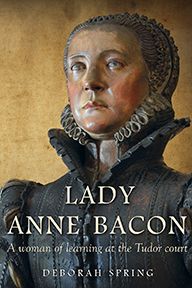
Deborah Spring’s Lady Anne Bacon: A Woman of Learning at the Tudor Court (University of Hertfordshire Press, 2024) is a splendid account of the life of Lady Anne Bacon (née Cooke). It effectively peels back the layers of time to reveal a remarkable woman’s life in early modern England. While Lady Bacon’s male family members are perhaps the best known – particularly her son Francis – it is Anne’s life that remains a marvel even four and a half centuries later.
Educated as any well-born early modern son would be, Anne and her sisters stood out. From a young age, Anne demonstrated her commitment to her studies, both classical and modern. This was even against her mother’s wishes in some subjects! Spring breaks down Anne’s life into themes, beginning with her childhood at Gidea Hall, her life at court under Mary I and her marriage to Nicholas Bacon, her role in the succession ‘crisis’ of 1553, her life in Elizabethan England, spent predominantly as a widow, and her commitment to reformed religion in England. This thematic and chronological approach allows the reader to easily follow Anne’s life, moving with her through her childhood and adolescence into adulthood and married life. Spring’s accessible writing style and attention to detail, particularly her skill in combing through Anne’s letters and financial records, reveal much about Anne’s life beyond her traditional roles and daughter, wife, and mother in a way that makes the reader want to keep exploring Lady Bacon’s exploits.
Where Spring especially excels is in her examination of Anne’s early life and in discussions of her widowhood. Spring has clearly spent much time with the primary sources relevant to these parts of Anne’s life, which allows the reader to engage even deeper with Anne’s learning and her role in and out of the court. Where Spring sometimes stumbles, though, is in keeping too in line with early modern expectations of gender. Although it is understandable that Anne’s married and widowed life revolved primarily around her husband, step-children, and children, there are times when Anne as an individual seems to disappear into the background in favour of Anne as a mother and a wife. The portrayal of Anne as ‘a woman of learning at the Tudor court’ slips away as Spring focuses more on Anne’s troubles with William Cecil and with her sons, all of whom work – however deliberately or ignorantly – to challenge her day-to-day existence and financial survival. Spring does, however, come back to Anne’s studies and translation towards the end of this work, reminding the reader of what an impressive woman Anne was.
Ultimately, Spring’s Lady Anne Bacon is a fascinating retelling both of Anne’s life and of the financial, court, and familial intricacies of early modern English life and serves as a foundational work not just for those wanting to know more about this particular woman but for those seeking to understand more about the environment in which she lived and worked.
____
My thanks to Chris Dunkley and the University of Hertfordshire Press for their invitation to review this work. For your own copy of Spring’s biography, head to the publisher’s website.
 Dr Johanna Strong